The top 5 trends shaping the software quality assurance market in 2026
- SQA

April 30, 2026
By Cindy Gann, Director of Business Development, Cambrionix
 |
Drawing on over 20 years of experience and deep engagement with hyperscale and enterprise software environments, Cindy Gann shares her perspective on the key trends shaping software quality assurance and real-device testing at scale. |
Software Quality Assurance has never been more strategically important, or more technically demanding. As development cycles accelerate and device ecosystems expand, SQA teams at the world's largest technology companies are under growing pressure to validate more software, faster, across a wider range of hardware.
Here are the five most significant trends defining the SQA landscape in 2026.
Trend 1: AI-driven development is accelerating release velocity
Generative AI and agentic AI tools are fundamentally changing the pace of software development. AI-assisted coding is helping engineering teams write and update software faster than ever before, which means the volume of releases requiring validation is increasing in parallel. According to Capgemini’s World Quality Report 2025–2026, GenAI adoption in quality engineering is surging, though enterprise-level scaling of these capabilities remains a challenge for many organisations.
There is a direct implication here. As development accelerates, so does the demand for real-device validation, which is where infrastructure becomes the critical variable.
Trend 2: Real devices are still the non-negotiable validation layer
Simulators and emulators are useful for early-stage testing at scale, but they cannot replicate the full range of real-world conditions. Hardware-specific behaviours, OEM differences, biometric flows, camera and performance constraints, network variability, and OS-specific quirks can only be reliably validated on physical devices.
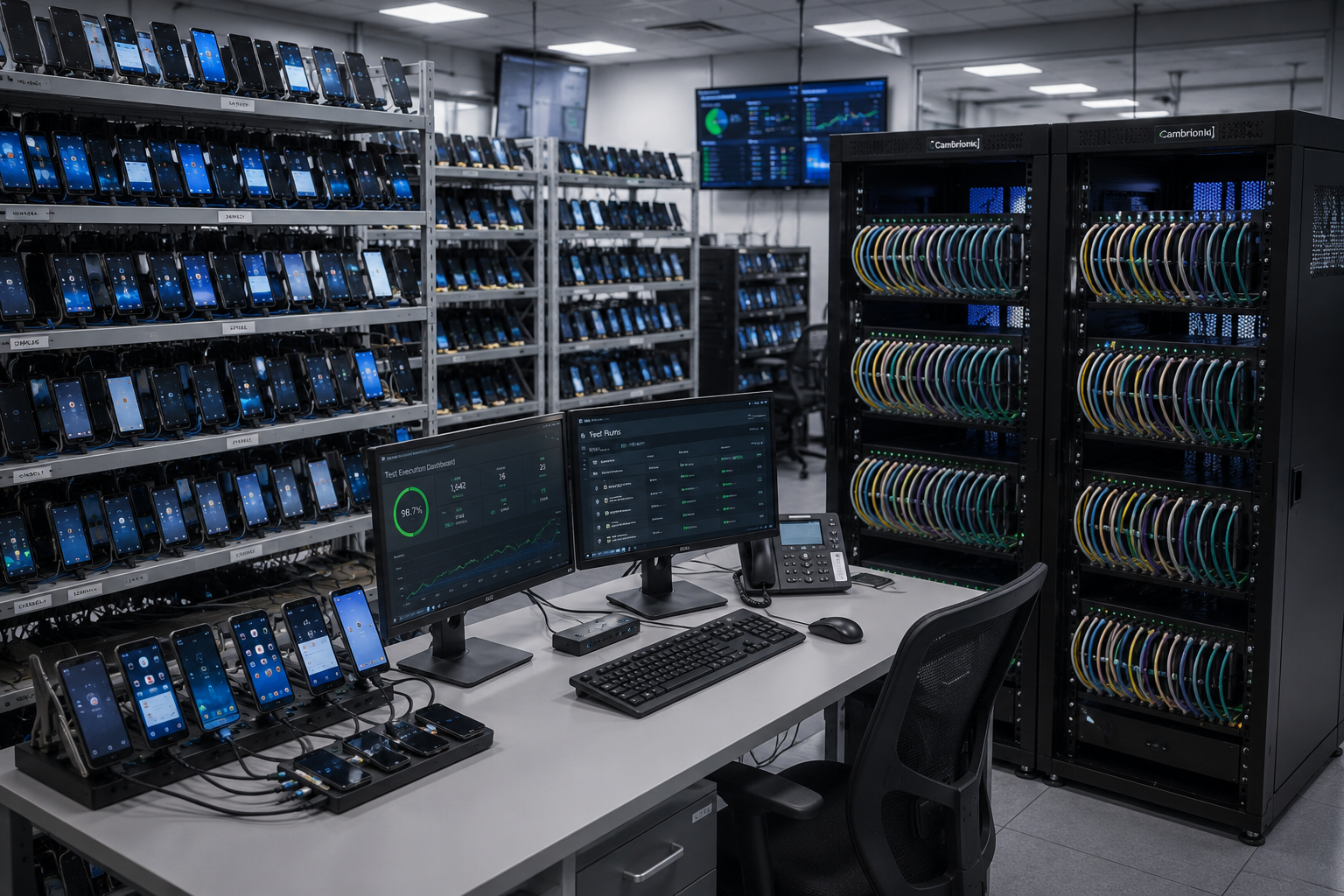
This is why the largest SQA labs - including those operated by companies like Google, Apple, and Meta - continue to run tests across tens of thousands of physical devices simultaneously. The approach is increasingly hybrid: use virtual environments to scale, and use real-device infrastructure to validate.
As the Google Android Lab has noted of Cambrionix solutions: “Cambrionix’s high-speed USB hubs seamlessly integrate with back-end systems and enable broader and deeper test coverage within a single test fixture, helping teams address more edge and corner cases effectively – accelerating development that delivers improved product reliability to end users.”
Real-device testing demand is also being amplified by the rise of wearables and connected devices, which require testing across phones, watches, earbuds and other form factors - each with distinct hardware and software requirements.
Trend 3: Release velocity gaps are exposing infrastructure bottlenecks
Despite advances in tooling and automation, many organisations are still not shipping at the pace they need to. The Sauce Labs State of Mobile App Quality 2026 report highlights a persistent release-velocity gap, with only a small percentage of teams shipping multiple times weekly and many still operating on monthly cycles. The constraint is often not the test tools themselves - it is the throughput of reliable real-device validation.
Teams are spending time resetting and restoring devices instead of running tests. Devices disconnect during heavy testing due to unstable USB infrastructure. Batteries run out during long automated test runs. These are consistent operational pain points reported across the industry. USB 2 and USB 3 hubs that cannot handle the power and data demands of intensive workloads become the bottleneck that delays software releases.
Trend 4: Intelligent power management is becoming a competitive differentiator
As testing workloads intensify, reliable charging is no longer a secondary concern - it is a core infrastructure requirement. Devices running out of battery mid-test, or experiencing power inconsistencies under load, directly cause failed test cycles and wasted engineering time.
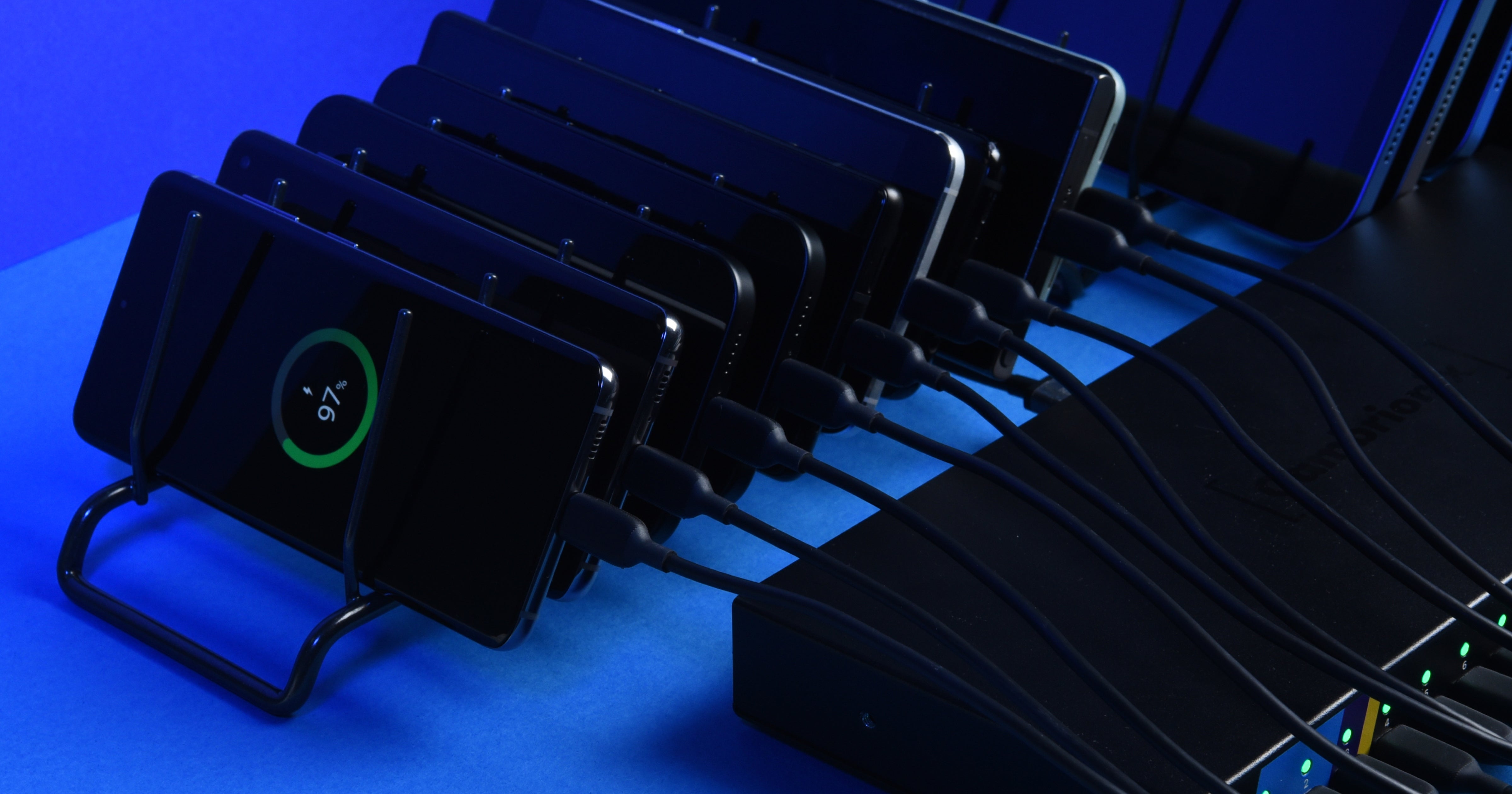
Intelligent Power Delivery (PD) - the ability to deliver the right, consistent level of power to each connected device based on its requirements – is emerging as a key differentiator between consumer-grade USB hubs and purpose-built SQA solutions. In combination with target charge levels configuration, teams can control how devices are charged during testing, preventing unnecessary battery strain while ensuring devices remain test-ready.
Beyond keeping tests running, intelligent charging has a direct impact on OPEX and CAPEX: managed charging reduces unnecessary power consumption, and maintaining battery health extends the lifespan of device fleets, delaying costly replacement cycles.
Trend 5: Automation and remote management are now baseline expectations
With device fleets running into the hundreds or thousands, manually managing individual ports and devices is no longer viable. SQA teams increasingly require the ability to monitor device status in real time, schedule charging sessions, remotely reboot or power cycle devices, and integrate hub management directly into automated testing workflows via APIs and CLIs. BrowserStack's recent launch of AI agents for software quality at scale reflects an industry-wide shift towards treating automation and orchestration as standard infrastructure, not premium add-ons.
Remote management is particularly important in large or distributed lab environments where physically locating and interacting with individual devices wastes significant engineering time. The ability to trigger workflows, manage power states, and respond to port errors from anywhere - without requiring physical access to the lab - is now a standard expectation rather than a premium feature.
Why the infrastructure foundation matters now
Across all five of these trends, one theme is consistent: the physical and software infrastructure underpinning real-device testing is a strategic asset, not a commodity. SQA teams that invest in high-density, reliable, intelligent device connectivity solutions are better positioned to ship faster, reduce downtime and scale their operations without proportionally increasing costs.